
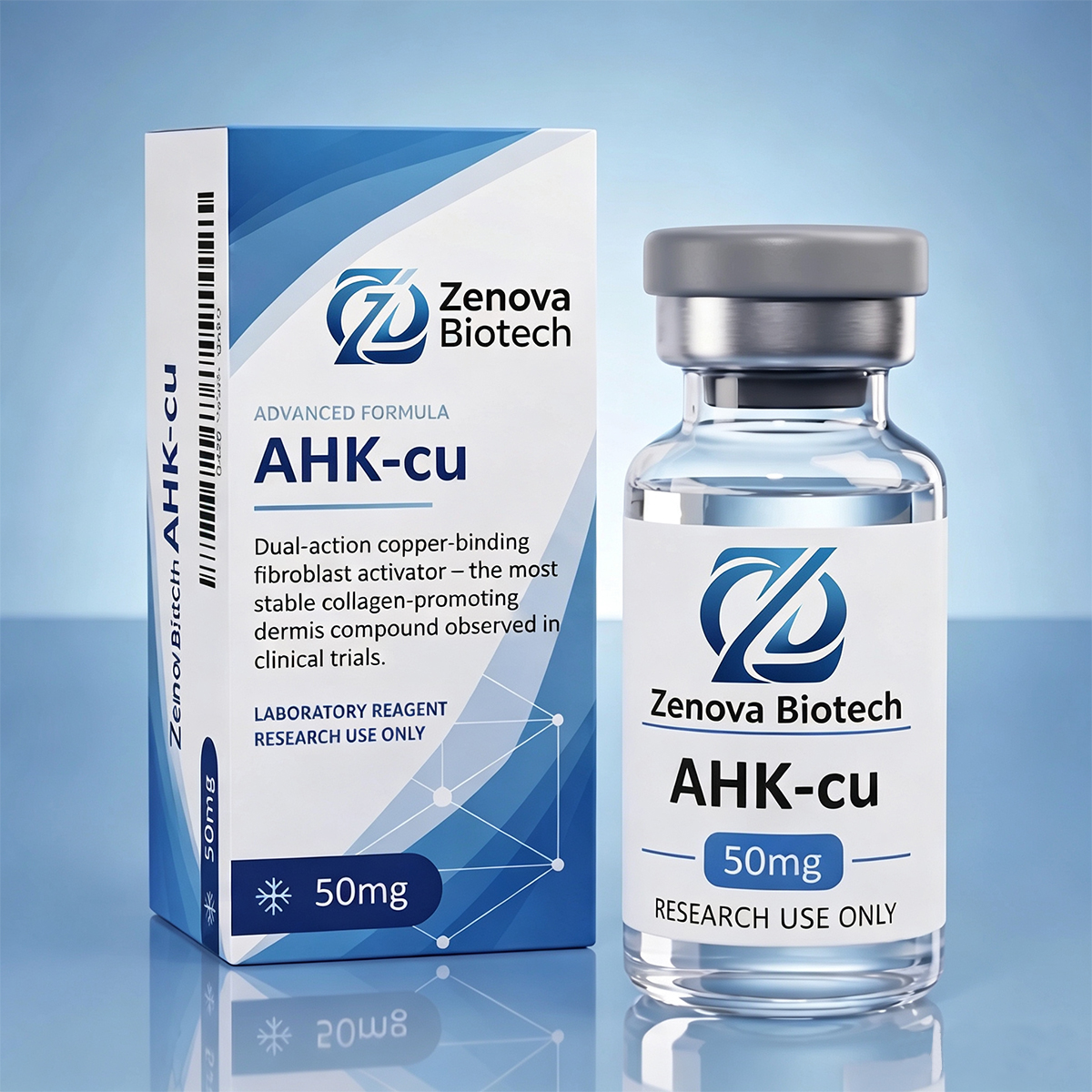

AHK-Cu is a copper complex of the tripeptide L-alanyl-L-histidyl-L-lysine (AHK), supplied in a nominal 50 mg catalogue presentation. The name describes a peptide–metal family rather than every solid-state detail: copper stoichiometry, protonation, counter-ion and water content must match the batch specification before an exact formula or molecular mass is applied.
Chemical and registry information
| Name | AHK-Cu; alanyl-histidyl-lysine copper complex |
| Peptide sequence | Ala-His-Lys (AHK) |
| Material category | Copper-binding tripeptide complex |
| Registry context | PubChem CID 168431292 describes a specific monohydrochloride representation; use it only if that exact form matches the batch |
| Presentation | Nominal 50 mg catalogue vial |
Research background and evidence
A published ex vivo and cell-culture study evaluated AHK-Cu in isolated human hair follicles and dermal papilla cells. The authors reported follicle elongation and dermal-papilla-cell proliferation under the tested experimental conditions, while the apoptosis result itself was not statistically significant. These preclinical observations are useful for mechanism and assay design, but they do not establish clinical efficacy, dosing or equivalence for a catalogue batch.
AHK-Cu is related to, but chemically distinct from, GHK-Cu. Replacing glycine with alanine changes the peptide sequence, so identity data and biological findings should not be interchanged between the two materials.
Technical comparison
| Aspect | AHK-Cu | GHK-Cu |
|---|---|---|
| Tripeptide | Ala-His-Lys | Gly-His-Lys |
| Shared feature | Copper-binding histidine-containing tripeptide | Copper-binding histidine-containing tripeptide |
| Analytical implication | Requires AHK-specific intact-mass, sequence, copper and counter-ion confirmation | GHK-specific data do not confirm AHK-Cu identity |
Quality, handling and storage
For copper-peptide materials, peptide identity, peptide content, total copper, peptide:copper molar ratio, free copper, counter-ion, water content and chromatographic purity are distinct attributes. Use only results linked to the exact lot and vial size.
Store and handle AHK-Cu according to the product label, matching CoA and SDS. Protect the material from contamination and conditions that could alter oxidation state or composition.
Sources
- The effect of tripeptide-copper complex on human hair growth in vitro.
- PubChem record for a defined AHK-Cu monohydrochloride representation.
Frequently Asked Questions
Is AHK-Cu the same compound as GHK-Cu?
No. They share a His-Lys motif and copper-binding character, but their first amino acid differs. Each requires its own identity and batch documentation.
Does the published hair-follicle study prove a consumer benefit?
No. It was an ex vivo and cell-culture experiment. It does not establish clinical performance or the suitability of this catalogue material for use on people.
Regulatory notice
This material is supplied for qualified laboratory research and is not an authorised medicinal product.
Reviews
There are no reviews yet.