
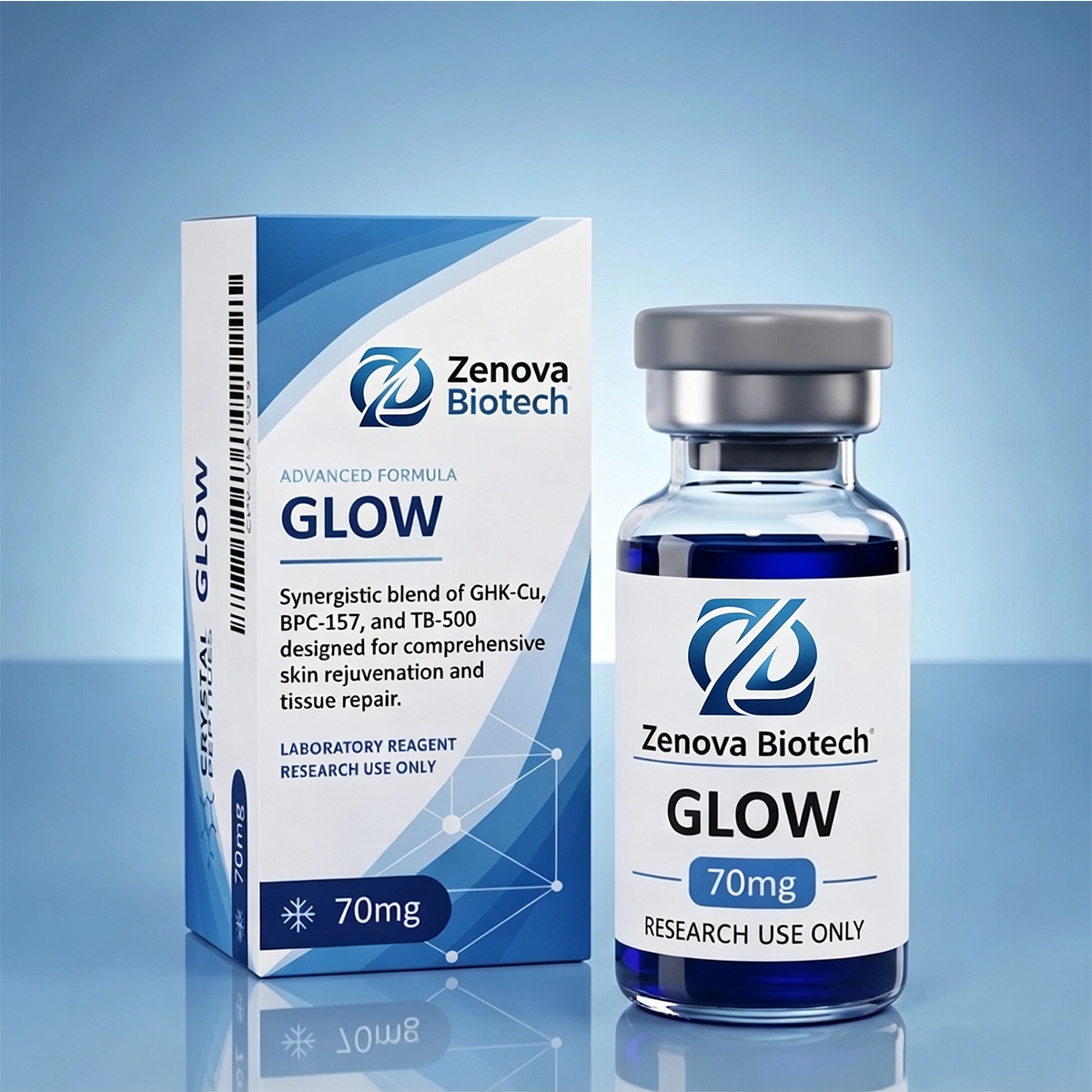

GLOW is a multi-component research blend supplied in a nominal 70 mg catalogue presentation. Because a proprietary blend name does not define a unique chemical entity, the exact component identities, material forms and quantitative composition should be verified against the matching batch Certificate of Analysis (CoA) and Safety Data Sheet (SDS).
Chemical properties and registry information
| Property | Value |
|---|---|
| Name and synonyms | GHK-Cu, Argireline, Leuphasyl Blend |
| Material category | Cosmetic Peptide Blend |
| Structural features | A blend of peptides, typically including GHK-Cu (Copper Tripeptide-1), Argireline (Acetyl Hexapeptide-8), and Leuphasyl (Pentapeptide-18). |
| Appearance | White to off-white lyophilised powder |
| Solubility | Soluble in bacteriostatic or sterile water. Reconstitute for topical application as directed. |
| Physical form | Catalogue vial; exact salt/counter-ion and excipients are batch-specific and must be verified in the CoA and SDS. |
Registry values apply only to the specific molecular entity, sequence, termini and material form. Batch records take precedence over family-level literature identifiers.
GLOW is a marketing name for a blend of cosmetic peptides, not a single chemical entity. The exact composition can vary but commonly includes GHK-Cu, Argireline, and Leuphasyl. As it is a mixture, it does not have a single sequence, formula, molecular weight, or registry number.
Research background and published evidence
Published research
Defined multi-analyte mixtures can support analytical-method development, separation, component identification, quantitative assay, compatibility testing and stability studies. Interpretation requires a documented formulation and component-specific analytical controls.
Current scientific understanding
Evidence concerning an individual component cannot by itself establish the identity, interaction, stability or analytical performance of the complete blend. Results should be interpreted only in relation to the confirmed formulation and batch.
Technical comparison
| Aspect | GLOW catalogue material | Single-component reference material |
|---|---|---|
| Identity | Defined by the complete batch formulation | Defined by one exact sequence or chemical structure |
| Registry data | No single whole-blend CAS number, formula or molecular mass | May have exact-form registry identifiers when the material form matches |
| Analytical approach | Requires component-resolved identity and quantity assessment plus blend-homogeneity controls | Can be assessed against a single-component specification |
Quality and testing
Quality information is batch- and presentation-specific. A report for another lot, size or similarly named material should not be treated as evidence for this product.
Identity, component quantity, chromatographic purity, total vial content, water or counter-ion content, sterility, endotoxin and elemental impurities are separate measurements. Only tests shown in a matching report should be regarded as available.
Laboratory handling and storage
Store and handle the material under the conditions stated on the product label, matching CoA and SDS. Keep the container secured, correctly identified and protected from contamination.
Laboratory preparation, analytical-method selection, risk assessment, personal protective equipment and waste disposal should follow the applicable SDS and the institution’s approved procedures.
Regulatory and legal status
| Research-use notice | This material is supplied exclusively for laboratory research by qualified professionals and is not intended for human or veterinary use. Purchasers are responsible for compliance with applicable local requirements. |
Sources and documentation
The matching batch CoA, SDS and approved product specification are the primary sources for composition, identity, quality attributes and storage conditions.
Frequently Asked Questions
How is the exact composition identified?
Use the approved product specification and matching batch CoA. The GLOW name alone does not define component identities, forms or ratios.
Does the 70 mg presentation define the quantity of each component?
No. It identifies the nominal total catalogue presentation; component-level quantities require batch-specific documentation.
How should the blend be stored and handled?
Follow the exact label, batch CoA and SDS together with the institution’s risk assessment.
Reviews
There are no reviews yet.